
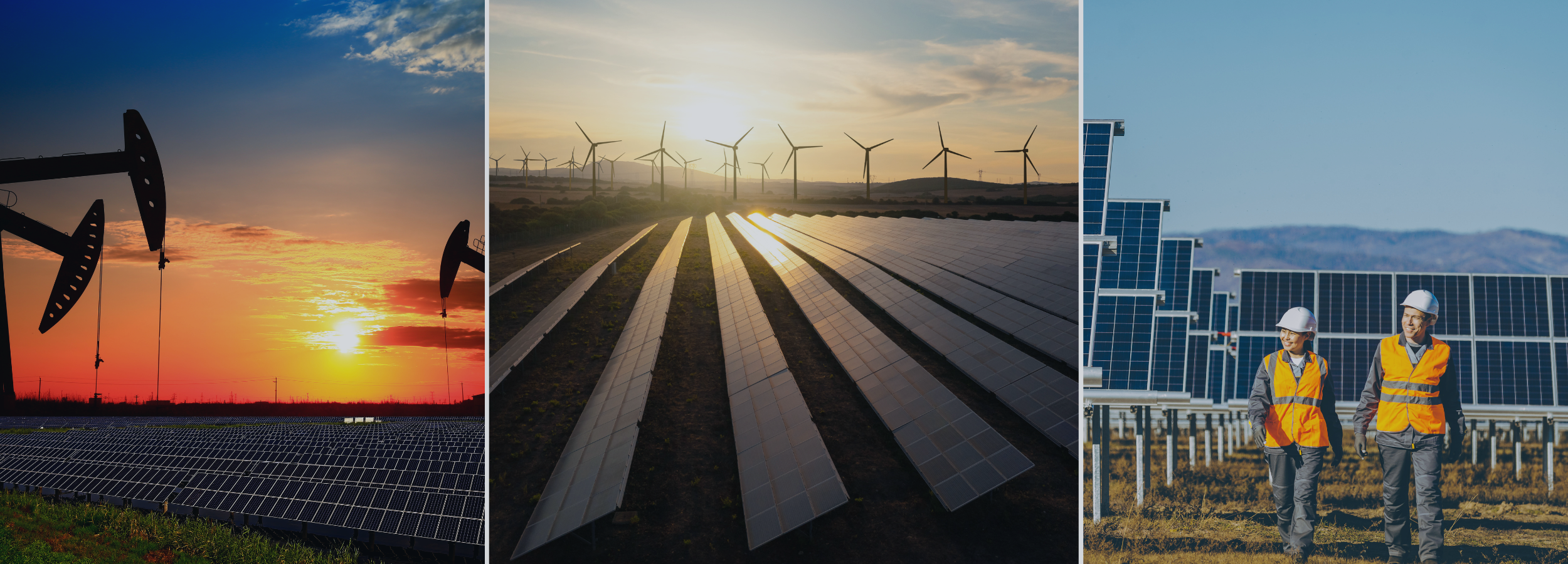
COMMON GROUNDS: Co-locating Wind and Solar Power on Federal Oil and Gas Land
Planet Reimagined is advancing an innovative bipartisan solution to sourcing the land the United States needs for large-scale solar and wind power projects
Where is the Common Ground?
The U.S. carbon free energy sector is expected to grow over the next decade, driven by favorable state policies and declining renewable energy costs. To maximize development potential and transition away from fossil fuel dependency, millions of acres of land will be required for new utility-scale solar and wind projects.
Planet Reimagined’s pioneering Common Grounds initiative has advanced an innovative way to help meet this huge demand—by enabling and incentivizing the use of up to 18 million acres of federal lands that are already leased for fossil fuel production. This strategy—set out in our 2023 Common Grounds report—won bipartisan backing, including a Congressional letter to the Department of the Interior. And in 2024, the Department of Interior indicated that for the first time in U.S. history, they will accept and encourage proposals for new solar and wind projects on top of oil and gas leases on federal lands. This landmark win led to the congressional introduction of the Co-Location Energy Act in December 2024.
Designed to attract a broad coalition of support, the Common Grounds model will reinforce national security, drive investment in energy communities, increase the productivity of federal energy lands, and ensure that undeveloped public lands remain ecologically intact—all while dramatically accelerating America’s broader transition to a clean energy future.

Featured on:


NEXT STEPS: Turning Research Into Action
With support across federal agencies, policymakers, climate organizations, and industry stakeholders, the Common Grounds team is now using our action research to prove the viability of this model. We are currently identifying three high-potential pilot sites on federal land in the intermountain West—sites that are now used for oil and gas production sites where utility scale solar facilities can be developed.
Additionally, we are building a coalition of partners invested in creating local, state, and federal incentives for renewable energy co-location on public lands, while making the economic case for co-location to local communities that are now heavily dependent on fossil fuel production.
Unlocking Potential
This approach will spur a range of benefits to frontline energy communities while accelerating America’s broader transition to a clean energy future.
Initial research indicates that there are approximately 18 million acres of land managed by the Bureau of Land Management with high potential for renewable energy generation that are actively leased for fossil fuel extraction. An additional 45 million acres across 30 U.S. States are also leased for oil and gas by State Land Trusts—creating additional potential opportunities that Planet Reimagined is exploring.
Small, independently owned producers, with an average of twelve employees, are the backbone of American energy, primarily located in New Mexico, Colorado, Utah and other states across the west where the federal government manages nearly 50% of all land. However, oil and gas employment rates have dropped by 60% in the past decade, despite higher production. As the United States continues to invest in the shift from fossil fuel reliance to renewable energy production, frontline energy communities will need customized resources to ensure that they can access the financial, environmental, and health benefits associated with the clean energy transition.
The Common Grounds co-location model will not only increase the amount of energy produced on federal lands. It will create new clean energy jobs. And it will help to sustain energy communities as fossil fuel activity sunsets.
Mapping Co-location Opportunities on Federal Lands
Using data published by federal agencies and leading institutions, such as the National Renewable Energy Laboratory, the Common Grounds team has established criteria for and identified key areas in which the co-location model can provide value to solar energy developers and surrounding communities. Ideal sites for the co-location of solar resources with fossil fuel operations on federal lands are those within two miles of transmission lines and with solar potential above the 75th percentile.
A Just Transition: Engaging Energy Communities
Hundreds of communities across the United States depend on the revenue coming from coal, oil, and natural gas extraction, including for essential services like schools and hospitals. These communities have fueled the country for generations. Co-location can help them drive the clean energy transition.
Using an environmental justice framework and human rights-based approach, Planet Reimagined is working with a variety of stakeholders to determine how best to structure Common Grounds pilot projects to benefit energy communities. This includes:
Structuring community benefit agreements to create revenue sharing opportunities from energy produced by the facility
Reaching out to communities and incorporating public participation into the project development process
Offering workforce development opportunities. We are actively engaging developers, impact investors, advocacy organizations, and community-based organizations to spur additional ways to create long-lasting positive impacts through this co-location model
A WIN-WIN-WIN

Siting renewable energy facilities on lands leased for fossil fuel extraction will drive investment in energy communities, increase the speed and efficiency of energy production on federal lands, and ensure that undeveloped public lands remain intact for future generations.
Explore how the Common Grounds co-location model is a win-win-win below:
-
Sustaining Communities
Co-location creates localized employment opportunities in clean energy and creates new funding streams for communities heavily dependent on oil and gas royalties
Leveraging Existing Assets
In addition to qualifying for federal and state energy incentives, developers can save money by tapping into fossil fuel era infrastructure, from access roads to transmission lines
Delivering a Healthier Future
Deploying both small-scale and utility-scale solar installations adjacent to oil and gas operations lays the groundwork for a future without these polluting sources
-
Building on Previous Work
Having gone through the permitting process once already, oil and gas lands have site-specific data that can be utilized for wind and solar projects, expediting the permit process and reducing project timelines
Proactive Planning and Permitting
By assessing and identifying sites and their potential environmental impacts ahead of time and on a national scale, local land managers can cut down on the time it takes to evaluate each individual project
Expanding Use
Disturbed lands are ideal sites for co-location projects because they hold reduced value as wild or working lands without significant restoration
-
Protecting Wild and Working Lands
By siting new solar and wind projects as much as possible on land already disturbed and designated for energy development, more public lands can be left alone
Preventing False Choices
Certain public lands have been prioritized for fossil energy development, even in instances where renewable resources on the same land are more suitable and profitable. By opening a pathway to land-sharing, a forced decision between energy types becomes irrelevant
Maintaining Environmental Protections.
Though co-location can benefit from standardized environmental review processes, it does not necessitate any changes to NEPA
Policy Recommendations

The co-location of renewable energy facilities on oil and gas lease lands can unlock development opportunities with immediate impact. Planet Reimagined is continuing to drive policy conversations at the federal and state level to establish incentives for energy land sharing and co-location.
Explore our policy recommendations in more detail below:
-
Proactively plan for renewable energy priority zones by identifying low-impact, high-potential sites
Ease permitting through a simplified environmental review process and make pre-screened sites easily accessible through an online dashboard
Align financial incentives for co-locating clean energy development with state and federal level environmental and equity goals
-
Create an Office of Just Energy Transition Technical Assistance and a “Transition in Place” Fund using federal revenues from oil and gas activities
Share revenue from wind and solar projects on public lands with local communities
Open the door to plugging and reclaiming wells to replace them with renewables
-
Mandate emission cutting measures, including on-site renewables deployment for operational use
Expand categorical exclusion to include small-scale, on-site renewable projects
Subsidize clean energy integration for “mom-and-pop” operators
A Bipartisan Letter from Congress

"A diverse energy grid through co-location is a sure-fire way to secure a resilient energy future for Utahns."U.S. Representative John Curtis (UT-3), Chairman, Conservative Climate Caucus
"I have worked with Planet Reimagined for a long time and have seen their advocacy for the future of our planet firsthand. This new policy report is innovative and proposes promising steps the Bureau of Land Management can take to move towards a clean energy future by co-locating renewable energy on lands already leased for oil and gas production."U.S. Representative Mike Levin (CA-49)Adam Met Talks Energy Policy Advocacy
In the News

TIME: Adam Met on Movement Building, Music, And His Path To Climate Advocacy

A Pop Star's Wonky Climate Campaign

WALL STREET JOURNAL: Bipartisan Backing to Explore Fast Tracking Solar and Wind on Oil-And-Gas Lands

CNN: Hitmakers AJR Turn Music into Environmental Activism
Our Partners


